T. rex Had a Body Temperature Similar to Humans, New Research Suggests
Paleontologists have long suspected Tyrannosaurus rex differed from modern reptiles, possibly being warm-blooded. Lacking direct methods like treadmills or thermometers for fossilized creatures, scientists analyze indirect evidence, such as the chemical makeup of fossilized teeth, to infer dinosaur metabolism and internal temperatures.
Researchers now claim to have established a specific body temperature for T. rex. Aradhna Tripati, a geoscientist at UCLA and study co-author, explained, "The enamel chemistry truly records the temperature at which it formed, and 66 million years later, we can read it using those measurements on a mass spectrometer. It’s the next best thing to sticking a thermometer up a T. rex’s ‘butt,’ which we wouldn’t have wanted to do anyway."
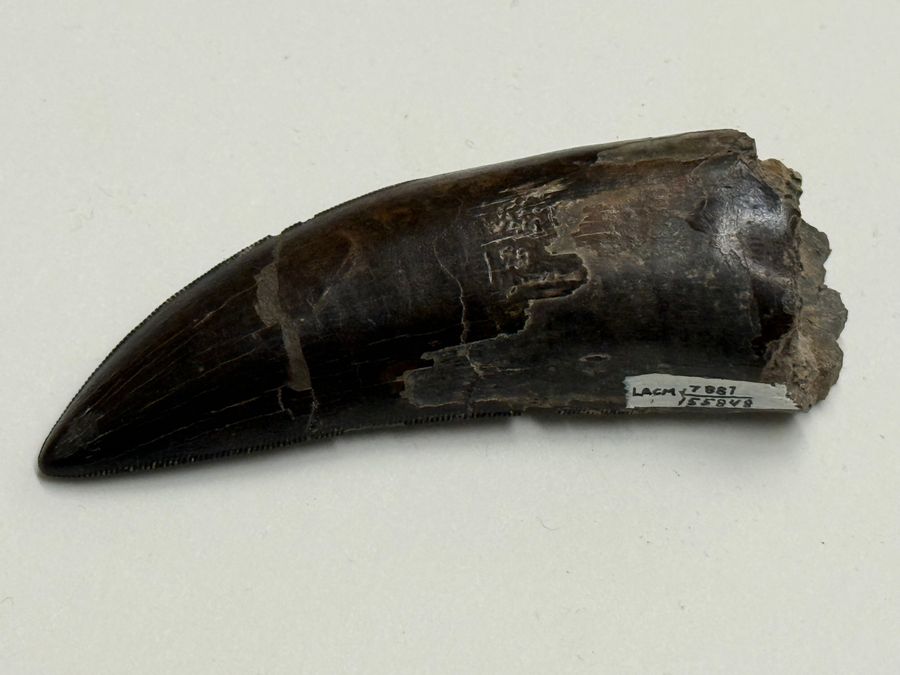
By examining isotopes in tiny fragments of T. rex tooth enamel found in Montana, scientists estimated the dinosaur's temperature. Their findings indicate T. rex likely maintained a body temperature around 36 degrees Celsius, similar to that of modern humans.
While previous studies have estimated dinosaur metabolism and growth, Tripati notes this method precisely gauges internal temperature because tooth enamel and thermodynamic estimates are less influenced by external environmental conditions.
Robert Eagle, a UCLA geobiologist and co-author, who developed this technique for prehistoric body temperatures, sees this as a culmination of 15 years of work. He plans to apply the same method to study the body temperatures of avian dinosaurs and ancient mammalian ancestors.
"I’m excited that it worked so well because we’ve tried a lot of things with this technique, but this really seemed to be a clear result," Eagle stated. "This gives me optimism that it’s going to be useful looking at other exciting questions."
These findings align with ongoing research into dinosaur physiology. A 2022 study indicated dinosaurs had varied metabolisms, with T. rex being on the lower end of endothermy. Jasmina Wiemann, a paleobiologist at Johns Hopkins University and lead author of that study, notes that the new paper's conclusion of T. rex body temperatures being more akin to large mammals than birds complements their previous work.
Wiemann describes the new study, published in Science Advances, as "absolutely mind-blowing" and "impressively precise." She suggests that based on this estimated temperature, T. rex could have inhabited diverse environments globally, including the Arctic.
"It has been really, really exciting to be a young scientist in the field and watching how the collective evidence that we have from different isotope data is converging toward the same picture, suggesting that most nonavian dinosaurs were probably warm-blooded," Wiemann remarked.
Fresh materials — Science News

Blockbuster Retatrutide Trial: A New Benchmark for Weight-Loss Drugs
The experimental weight-loss drug retatrutide has reached a significant milestone: a Phase 3 clinical trial showed participants with type 2 diabetes losing up to 49.6 pounds, or over 20 percent of their body weight. Eli Lilly, the drug's developer, reported this as a first for the field.

NASA Pursues Uncrewed and Crewed Missions with Boeing's Starliner
Boeing's Starliner spacecraft will attempt to fly NASA astronauts to space again, this time following an uncrewed test flight to the International Space Station (ISS). NASA administrator Bill Nelson announced that the capsule is scheduled for an uncrewed mission as early as December. This represe

TikTok promotes home remedy that risks botulism
A homemade concoction of garlic fermented in honey, trending on TikTok for its supposed immune-boosting properties, carries a serious risk of causing botulism, according to health experts. Influencers on the platform are promoting this mixture in numerous videos, claiming it

Trump's Proposed Executive Order on NIH Funding: A Threat to Scientific Independence and Innovation
A reported plan by President Donald Trump to establish a committee that would oversee, and potentially veto, scientific grants from the nation's leading health agency could diminish U.S. scientific and innovation leadership, according to advocates and researchers. This proposed

Missing Pages of Henry VIII Manuscript Rediscovered
Six pages, missing for centuries from a 600-year-old religious manuscript, have resurfaced. This book once belonged to an attendant of King Henry VIII and offers insights into the religious changes and shifting loyalties of the Tudor court. The book, Mirror of the Blessed Life of Jesus Chri

Japan Achieves Centenarian Milestone: Over 100,000 Citizens Reach 100+
The number of people living to 100 or older in Japan has surpassed 100,000. This new record indicates a continued increase in global lifespans. Japan's high life expectancy is attributed to several factors: low obesity rates, healthy eating habits, widespread medical check-ups, and accessible he